CBOTB

Monday, November 16, 2015

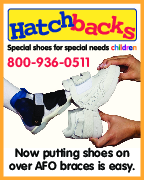
Shoes That Accommodate AFOs

An OT friend of mine brought this to my attention, so I thought I would pass it along.  So many parents have a hard time finding shoes to fit over their kids' AFOs.  These shoes accommodate for that.


Hatchbacks- Orthopedic shoes for kids

Find the link to the website here:  http://www.hatchbacksfootwear.com/


Thursday, September 17, 2015

Bilateral Skills- Using 2 hands together


Bilateral skills (using 2 hands together) develop early on- babies often hold something in each hand and bang them together in front of them.  Developmentally, babies then start to hold something stationary in one hand while using the other hand to manipulate it or to do something else with the working hand (think of a baby holding a toy in one hand while using the other to explore and manipulate it). Then, they progress to using both hands at the same time to do different movements (think of a toddler pounding a toy hammer with one hand while reaching to grab another toy with the other).  Some early indicators that your child may have not developed good bilateral skills may be if your child skipped the crawling phase, was a late walker, or seems generally uncoordinated.  If a child has difficulty with bilateral skills, they can also have difficulty with balance, using their 2 eyes together efficiently and have difficulty using both hands together in a coordinated manner.  It could also affect their language skills.

Bilateral activities include any activity that requires the use of 2 hands or both sides of the body to complete:
  • hold a bowl with one hand and stir with a spoon to mix
  • hold/stabilize a cup with one hand and pour from another container into it
  • scoop up sand/rice/beans/toys with 2 hands together and fill up a bucket or container
  • lace a lacing card
  • cutting tasks- hold the paper in one hand while cutting with the other
  • paper punch activities
  • crunching up tissue paper to use for an art project, or crunch up scrap paper or newspaper into a ball and throw into a basket 
  • gluing tasks (with a glue stick or liquid glue)- apply glue to paper and use other hand to place another piece of paper or item (such as a pompon) on the glue spot
  • tear paper
  • play with a wind up toy (hold in one hand while winding it up with the other)
  • complete a wrapping task- wrap yarn around a cut out shape of cardstock
  • stringing beads
  • playing with link together toys, like legos or pop beads
  • drumming
  • riding a trike/bike
  • tracing stencils or tracing around your hand
  • spread frosting or peanut butter on a cracker
  • jump rope
  • animal walks/crawling
  • catching a ball
  • carrying a tray or boxes with 2 hands
  • stabilize a piece of paper with one hand/forearm while coloring or printing with the other
  • clapping- clap hands together to pop bubbles in the air
  • jumping jacks
  • completing fasteners and self help tasks- buttoning, snapping, zipping, tying shoes, putting clothing on
  • opening and closing containers- unscrewing and taking lids off of containers
  • rolling out play dough or cookies using a rolling pin, rolling out a snake or roll into a ball
  • skipping, galloping, going up and down the stairs or climbing a ladder 
  • playing on playground equipment incorporates numerous bilateral movements
Tuesday, August 11, 2015

Why It Makes Sense to Learn Capital Letters FIRST~

I didn't write this blog post, but I couldn't possibly say it any better than this post from 'Play to Learn Preschool" does.  It is full of information regarding why preschoolers (and kindergartners, for that matter) should learn to print their capital letters first.  It just makes developmental sense!  Read more about it here:  http://www.playtolearnpreschool.us/2015/08/learning-to-write.html
Enjoy!

Thursday, July 9, 2015

Play Outside!


I always tell my little friends' parents to take their kids to the playground and play.  Play is an essential part of child development and physical activity is an essential component of that. Playing on playground equipment promotes development and provides stimulation in so many ways...

What can playground equipment promote?

  • Promotes better range-of-motion for all muscles/joints
  • Upper body/arm strength, grip strength
  • Eye Hand coordination, bilateral coordination
  • Lower extremity strengthening
  • Improves overall stability & balance
  • Strengthens the core muscle group; this leads to good posture and balance
  • Provides cardiovascular exercise
  • Promotes motor planning
  • Sensory stimulation: proprioceptive (heavy work to the muscles and joints), vestibular (movement of the head in space), tactile input
  • Promotes social skills/peer interaction
If you have a child who becomes overstimulated by too many kids/too much activity at the park/playground, search your community parks and rec web sites to find smaller, out of the way parks/playgrounds that are quieter and likely less visited.  Here is a link to a listing of all of the parks in Minot, ND:  http://minotparks.com/parks/

Want other park/rec options in the Minot area that would be a great day trip?  
Try the Velva, ND Park/Pool:  http://velvand.com/?page_id=151


Wednesday, July 8, 2015

Anxiety and a Genetic Link?

I come from a line of anxious people...so does my husband.  So, it's really no surprise to us that our only biological child's apple does not fall far from the tree!  (We have 2 children who were adopted as well, but they are not really the anxious type.)  A friend passed this article along to me, and I found it interesting enough to share.  A lot (if not most) of kids on the autism spectrum have significant anxiety/fight or flight responses, and this makes one wonder about how genetics might be linked to autism in this same manner.  Take a look at the findings:  http://neurosciencenews.com/parental-anxiety-offspring-psychology-2202/

Friday, May 29, 2015

Summer Reading for Parents and Practitioners~


Today is the last day of work before summer vacation for me, so I thought I would add a summer reading list of excellent resources that I have compiled for parents and other practitioners/educators to look into.  Enjoy~

  • “The Out of Sync Child,"  by Carol Stock Kranowitz.
  • “The Out of Sync Child Has Fun," by Carol Stock Kranowitz
  • “Sensational Kids, Hope and Help for Children with Sensory Processing Disorder," by Lucy Jane Miller.
  • “The Sensory Sensitive Child," by Karen A. Smith and Karen R. Gouze
  • “Too Loud Too Bright Too Fast Too Tight,” by Sharon Heller
  • “Raising a Sensory Smart Child,”  by Lindsay Biel and Nancy Peske
  • “Raising Your Spirited Child: A Guide for Parents Whose Child Is More Intense, Sensitive, Perceptive, Persistent, and Energetic,” by Mary Sheedy Kurcinka
  • "Sleepless in America: Is Your Child Misbehaving...or Missing Sleep?"  by Mary Sheedy Kurcinka
  • “10 Things Your Student with Autism Wishes You Knew,” by Ellen Notbohm
  • “10 Things Every Child with Autism Wishes You Knew,”  by Eleen Notbohm
  • “Almost Autism: Recovering Children from Sensory Processing Disorder: A Reference for Parents and Practitioners,”  by Maria Rickert Hong
  • “Smart but Scattered: The Revolutionary “Executive Skills” Approach to Helping Kids Reach Their Potential,”  by Peg Dawson and Richard Guare
  • “Smart but Scattered Teens: The “Executive Skills” Program to Helping Teens Reach Their Potential,” by Richard Guare and Peg Dawson
  • “Shut Up About Your Perfect Kid: A Survival Guide for Ordinary Parents of Special Children,”  by Gina Gallagher & Patricia Konjoian
  • “Growing an In-Sync Child: Simple, Fun Activities to Help Every Child Develop, Learn, and Grow,”  by Carol Kranowitz and Joye Newman
  • “The Elephant in the Playroom: Ordinary Parents Write Intimately and Honestly About Raising Kids with Special Needs,”  by Denise Brodey
  • “Late, Lost, and Unprepared: A Parents' Guide to Helping Children with Executive Functioning,”  by Joyce Cooper-Kahn and Laurie Dietzel
  • "The Occupational Therapist's Handbook for Inclusive School Practices," by  Julie Causton and Chelsea P. Tracy-Bronson

Monday, May 18, 2015

Alert Me Bands


One of my little friends wears an Alert Me Band-  It is a high quality wristband that is childproof, adjustable and customizable; it indicates medical, special needs, allergy & emergency contact alerts. Exceptionally durable and waterproof, this would be a great investment for kids with autism. allergy issues, communication issues, etc., not to mention the peace of mind that it would provide for parents. You can find the web site here:  http://www.alertmebands.com/  Or, you can locate and "like" the company on Facebook.  :)