CBOTB

Thursday, April 16, 2015

Thinking Spring with a Spring Theme Group Activity

I have been working in some classrooms lately that have spring themes going on in their curriculum.   It's fun to look for ways that I can incorporate something similar into group activities and work tasks as I am able to.  I did the following activity for one of my group sessions with a classroom of kids with various disabilities/abilities:

Pine Cone Bird Feeders

You need:
  • pine cones 
  • shortening (you can also use peanut butter, but to avoid allergy issues, I use shortening)
  • bird seed
  • string
  • knives or spatulas for spreading
  • zip lock bags
Spread the shortening on the pine cone.  This is a good bilateral task (using 2 hands together).  


For kids who have less fine motor ability or who need hand over hand assistance, spatulas work better than knives.


Sprinkle the shortening covered pine cone with birdseed.  This is a good way to work on finger to thumb opposition and to get some tactile stimulation from the bird seed.


Tie a string around the top of the pine cone (this is good to do before you even start, but in the course of getting started, we forgot!), and place the pine cone bird feeder into a zip lock bag for the students to take home. 


Hang in a tree to feed the birds!  

Thursday, April 2, 2015

Tuesday, March 10, 2015

Working on Coloring Skills~

I have several kids on my caseload who do not enjoy coloring- these are usually the kids with poor fine motor skills or weak hands.  They also are usually not fond of crayons and prefer markers- crayons require more pressure and offer more resistance than markers do.  I would suggest to parents and educators that this is exactly the reason that crayon use should be encouraged!  Here are some ways to work on coloring skills with your kids/students:

  • Crayons require more pressure for the colors to be bolder.  This is good for kids who have weak hands or who have sensory issues that make it difficult for them to grade the pressure that they exert.
  • Keep in mind that developmentally, coloring on a vertical surface comes before coloring on a horizontal surface (ever notice how kids like to color on walls when they are toddlers?)  So, use an easel when coloring, or tape the paper to the wall.
  • To encourage a refined grasp pattern on a crayon, you can have your child use larger diameter (Jumbo) crayons, triangular shaped crayons, left right crayons, finger tip crayons or use old short/broken crayons to facilitate a more finger tip grasp pattern.  
  • Crayons offer more resistance on the surface of the paper- this provides more sensory feedback than markers do.  Other ways that you can offer more sensory feedback when coloring:  put a piece of sand paper underneath the paper (more coarse paper provides more feedback), put a piece of plastic craft mesh under the paper.
Coloring with sand paper under the paper for more sensory feedback

Raised lines on a coloring page from use of a glue gun
  • Does your student or child keep his or her forearm up off of the table when coloring?  It is important for the weight bearing side of the hand and forearm to be touching the table top.  To encourage this, have the child lay on the floor while coloring.  You might also accomplish this by taping the paper to the wall, and having the child lean their forearm on the wall as they color.
My own child laying on her bed, coloring an art assignment~

Friday, March 6, 2015

Play Dough and Tactile Play


When my T. was a little girl, she could entertain herself for hours with Play Doh.  She's also my sensory girl~  some kids do love Play Doh and other types of tactile sensory play.  There are all kinds of ways to use Play Doh:

-You can just have kids create what they want.  How cool are these 2 creations??  2 of my 3rd grade boys made these; they had a great time creating them, and were so proud of how they turned out:

C's Play Doh shark creation~
B's Play Doh whale creation~
-You can embed different items in the Play Doh and have the kids find them and dig them out.   Pony beads and Therapy putty charms are some of my fave things to use for this; putty charms can be found at the Therapy Shoppe web site:  http://www.therapyshoppe.com/category/P3086-therapy-putty-charms-sensory-toys-tools-special-needs

-Buy some birthday candle holders and some candles; push the candle holders into the playdough and add the candles for some fine motor precision.

Credit to Miss Denise for this fun idea!

-Roll it out like a snake and cut it into pieces with a scissors to work on cutting skills
-Press it out flat with hands or roll it flat with a rolling pin and cut long strips with a scissors, or use cookie cutters and stampers to cut out and stamp shapes into it
-I kept several of my own kids' old Play Dough sets that are fun for kids to play with, too

Of course you don't have to use just playdough- you can play with theraputty, Cra-Z-Sand, rice, dried beans, pasta, water, shaving cream, karo syrup and food coloring, or make make your own recipes for tactile play (see my post for "messy play" here:  http://fabulousfriendsot.blogspot.com/2013/07/the-tactile-system-and-some-messy-play.html)

Cra-Z-Sand has been a real hit with students lately!
I have sea creature putty charms embedded in this~

Wednesday, March 4, 2015

Dr. Seuss Activities~

Ask any kid in elementary whose birthday it is this week, and they will tell you~  Dr. Seuss!!  Who doesn't love Dr. Seuss books??  So, keeping with the theme of Dr. Seuss this week, I have used the following activities (of course you can use them any time, not just for Dr. Seuss week):


Bingo Dabber Dr. Seuss Activity

  • You need:  red and blue bingo dabbers
  • Cat in the Hat mosaic printable.  You can download this Dr. Seuss printable for free here:      https://www.dropbox.com/s/sqa88gvvzjjcd4b/MosaicCatintheHat.pdf
  • I presented visuals so that my little friends would know that the red goes on the circles and the blue goes on the squares


The triangles could be dabbed white, but we left them.  I don't have a white bingo dabber (do they even exist?), but you could use a white shoe polish dabber, or a small sponge square on the end of a clothespin and dip it in white tempera paint.

Cat in the Hat Unifix Cubes
This is just a simple activity that you can use to work on patterning, sequencing and finger strengthening.  The kids knew right away that they were making the cubes look like the Cat's hat!


One Fish, Two Fish, Red Fish, Blue Fish Fish Bowls
You will need the following:
  • tag board cut out in the form of a fish bowl (I made my own pattern)
  • karo syrup
  • blue food coloring
  • construction paper cut outs of red and blue fish
-Pour some karo syrup on the tag board fish bowl
-Add a drop of food coloring on the syrup


-Have the kids rub the syrup and food coloring on the fish bowl, covering the surface (if they are reluctant to touch it, you could have them wear vinyl disposable gloves or use a paint brush)


-add the red and blue fish cut outs while still wet so that they stick


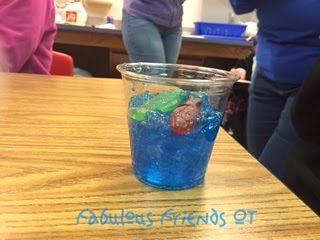
Jello Fish Bowls
You will need:  
  • Blue jello
  • clear plastic cups
  • large spoon for scooping
  • Swedish Fish
-Work on scooping and filling and using 2 hands together by having the students hold onto the plastic cup as able and fill it with blue jello


-Top with a couple of Swedish Fish

Tuesday, February 17, 2015

Straw Sensory Play Activity


This box of cut up straws is a fun way to make a non messy sensory play activity!  I bought 6 packages of 150 count drinking straws at the dollar store, and cut them up into thirds (but you could make them smaller or larger).  I used a copier paper box (the kind with a removable lid on the top), and cut a large rectangular hole in the lid.


I then added some random toys/objects in the straws, so that my students can reach in and find them-  you could:

-Take off the lid and just have the kids play in the straw however they want.  
-Have them find objects that you have hidden in the straws (this helps work on tactile discrimination and stereognosis!), eyes open or eyes closed.

What is tactile discrimination?  Wikipedia defines it as "the ability to differentiate information received through the sense of touch."

What is stereognosis?  According to Wikipedia, it is the ability to perceive and recognize the form of an object in the absence of visual and auditory information, by using tactile information to provide cues from texture, size, spatial properties, and temperature, etc.

-Vary the size of the objects that you have in the straws.  Smaller items require more tactile discrimination.
-Kids love the non messy aspect of this tactile input/stimulation~


I used this tactile box for a group activity in a classroom of 9 kids; all have various disabilities.  Some of the kids require visual cues to follow directions and to sequence the steps of an activity, so I also made visuals (using Boardmaker) for those that needed those types of cues:


Be creative with ways that you can present this to your kids/students, modify how to access it, vary the items that you add to it...

Friday, January 30, 2015

Dysgraphia App

You may have a child in your classroom, on your caseload or in your home who avoids handwriting at all costs...maybe the reason that they are avoiding writing is not clear.  Do they have poor motor skills that are causing them difficulty?  Is the process of writing fatiguing because of poor handwriting mechanics?  Is it because he or she can't seem to get their thoughts out of their head and on to the paper?  Is there anxiety related to doing work?  Maybe they have dysgraphia?  What is dysgraphia??  Dysgraphia is a type of learning disability that affects writing.  Kids with dysgraphia might have difficulty with spelling, poor/illegible handwriting or have trouble getting their thoughts down on paper.  Dysgraphia is actually a processing issue, though, not necessarily a motor issue alone, so just because a child has poor handwriting, it does not mean they have dysgraphia.  In certain cases, maybe a child is a non-writer, but can type on a keyboard. No matter what the cause, there is the question of how to best address illegible handwriting on worksheets.  Sometimes we require the kid to re do their papers so that we can read it.  Sometimes we have an adult/paraprofessional scribe for them...  Wouldn't it be great if there was a way that our students could type their answers on their worksheets so that we could read it and so that independence with handwriting and completing worksheets could be addressed?

A colleague and friend of mine (thanks, Nichole!) shared this the other day, and I wanted to pass it along to my readers~  It is a FREE app for dysgraphia called SnapType that allows you to take a picture of a worksheet using an iPad, and then your child can type their answers on the iPad vs. having to write them out.  Of course you can use this for any handwriting related issue where illegibility or getting thoughts on paper is impacting work performance.  Read about the inspiration behind the app and some more specifics here:

http://www.additudemag.com/adhdblogs/30/11108.html